The lesson
The only light in the centre
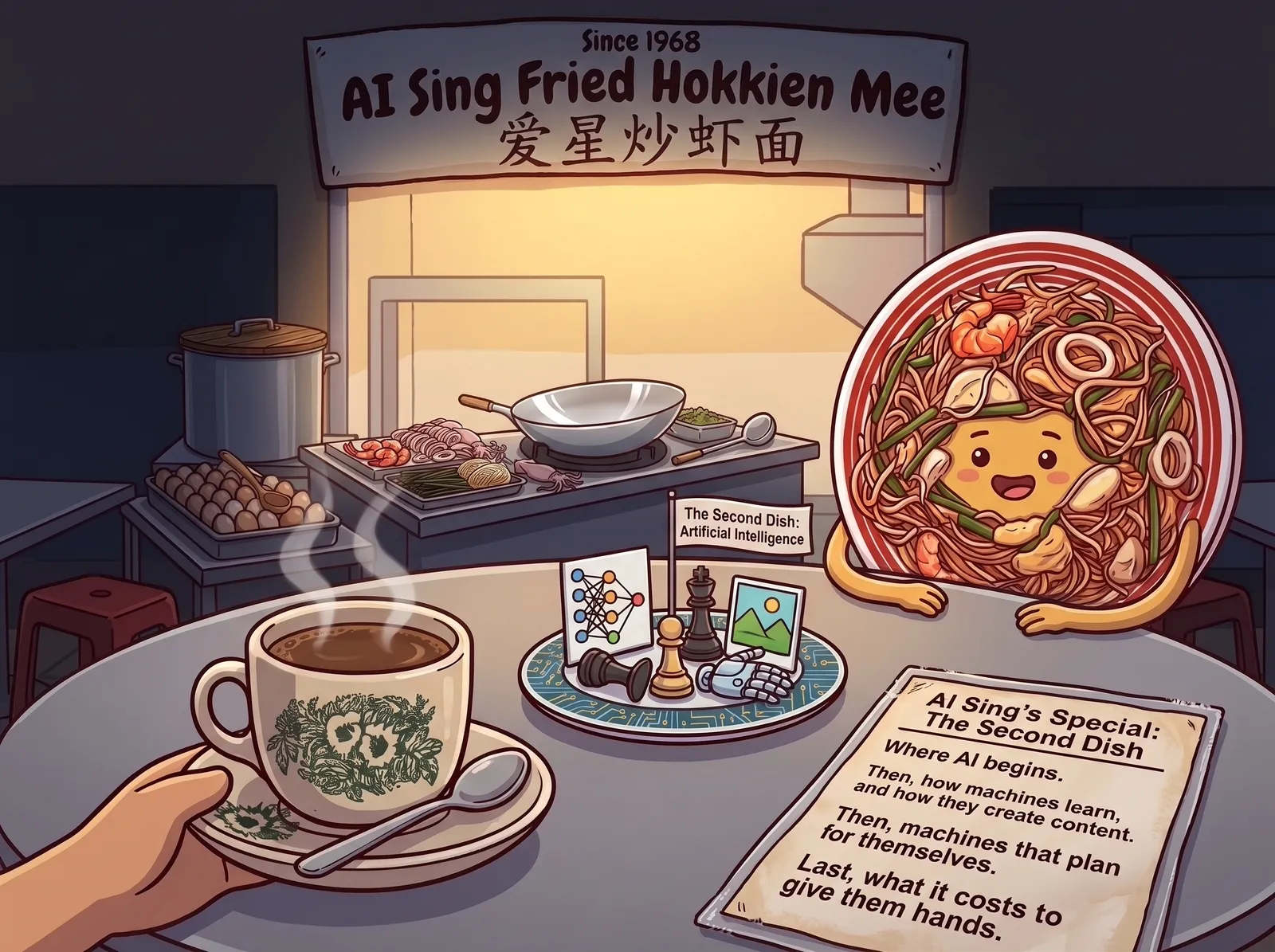
It is 4:30 in the morning. My stall is the only one with the light on in the whole hawker centre. I sit down at the table in front of my stall with you, and hand you a cup of kopi. You are my first customer. You came for my Hokkien Mee, and you will get it. But I am serving a second dish. That dish is artificial intelligence. Here is the menu. First, where AI begins. Then, how machines learn and create content. Then, machines that plan for themselves. Last, what it means when we give them hands. My promise is simple. By the last plate, the technology news about AI will make sense to you.
What AI is, and what it is not
Let me clear the movies out of your head first. AI is not a small person living inside a machine, thinking and plotting. It is a machine that learns from examples. A hawker learns the same way, from years at the wok. Rain is coming at noon? I know the office crowd will stay in and order delivery, so I order fewer noodles. The morning seafood arrives? I sort it. The glossy prawns go into my pot. The dull ones go into the rubbish bin. A regular says the noodles today was salty. I adjust, and tomorrow I cook a little better. That is the whole package. I predict, I classify, and I learn.
Now picture one straight line, and put every machine on it. At one end sit the rule followers. A calculator obeys its keys, and it never gets better at arithmetic. At the other end sit the learners. Every learner improves with experience. I live at the learning end. So does AI. Feed a machine enough examples, and it acts as if someone had written it a rule. The examples taught the learners how to predict, classify or group things.
You already live at the learning end
You already live at the learning end, whether you notice. Your phone unlocks at a glance. It learnt to read your face from millions of photos. Your map warns you of a jam ahead. It learnt from years of morning traffic. Your keyboard suggests your next word. It learnt from you. So when a company says its product uses AI, it nearly always means one thing. Many examples taught the product’s AI, and the AI adjusted itself until it became good.
Real AI, or movie AI?
Now let me test you. I will make three claims. After each one, ask yourself: real AI, or movie AI?
Claim one. Your phone unlocks the instant it sees your face. Real, or movie? I give you three seconds.
Pause here for three seconds.
Show the answer
… Real.
Claim two. An app writes a birthday poem for your Ah Ma in 10 seconds. Real, or movie? Three seconds.
Pause here for three seconds.
Show the answer
… Real.
Claim three. A robot feels hurt when you walk past its stall. Real, or movie? Three seconds.
Pause here for three seconds.
Show the answer
… Movie.
Two of the three are learners with enough examples behind them. The third is a story about feelings. No matter how many examples you throw at it, the AI will never understand feelings.