The lesson
Imagining the next cook
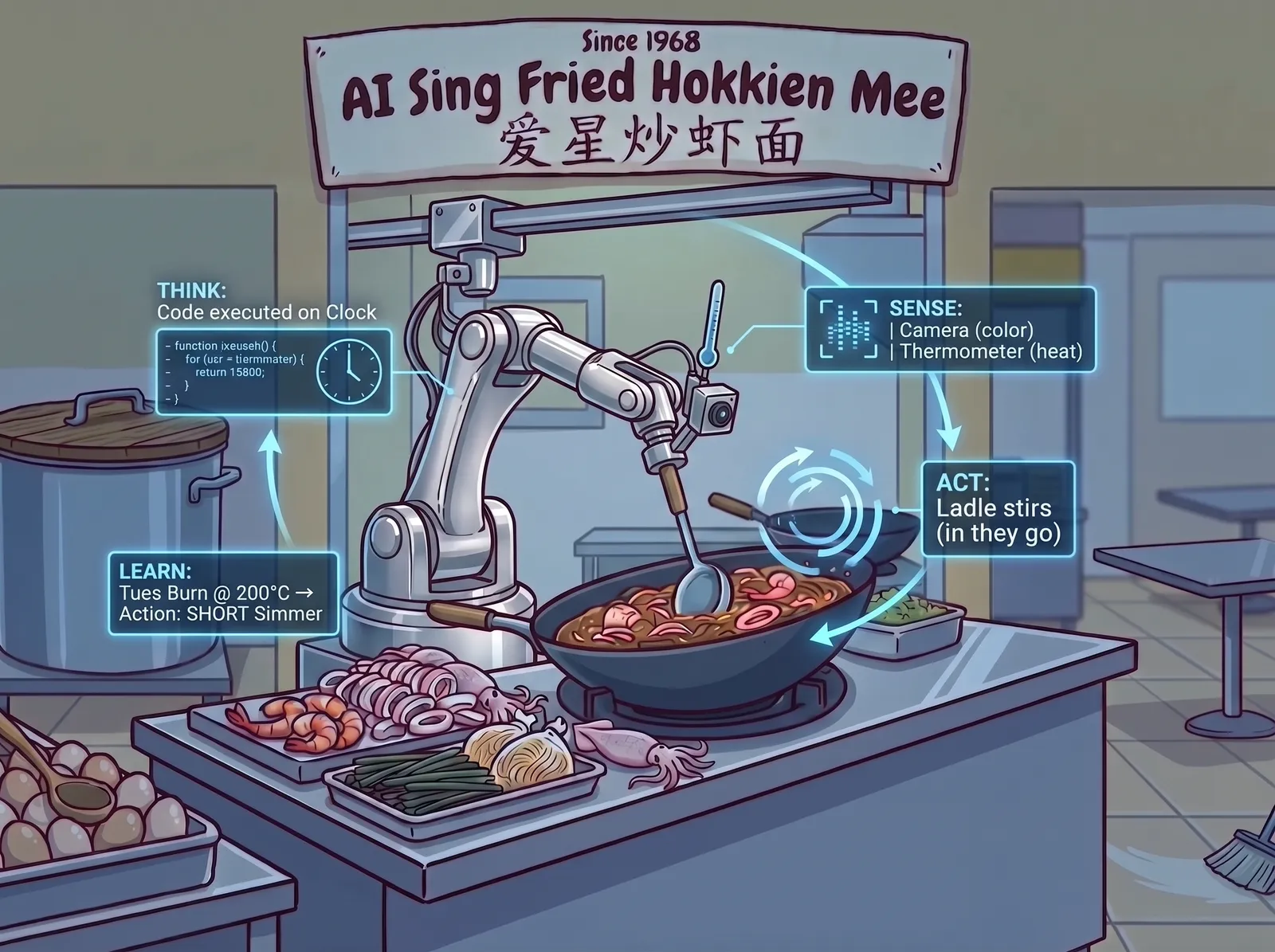
It is closing time at my stall. The flame is off, the floor is swept, and I imagine this stall with a different cook. Same wok. Same sign. But a stainless-steel arm on a rail where I stand. Could that arm really run a Friday night? You would have to know what a Friday night is, second by second.
Sense, think, act, repeat
Every second, the arm runs a loop: sense, think, act. Sense: the thermometer reads the heat, and the camera reads the colour of the noodles. Think: the noodles go in now. Act: the ladle stirs, and in they go. Then comes a fourth step, learn. Too much stock and the noodles become soggy, so less stock tonight. A hawker runs the same loop several times inside 1 stir. The robot must run it in code, on a clock.
Before it earns a Friday night, the robot practises on a digital twin, a software copy of my stall. In the twin, it stirs millions of virtual plates in fast-forward, and failure is free. Burn a virtual stock. Drop a virtual plate. The real stall stays clean, and the robot tries the night again. Moving from the twin to the real stall has a name, sim-to-real. The twin is tidy, but the real stall fights back. The real wok has dents. The gas flickers in the wind. Sim-to-real is where the robot’s illusions meet gravity, heat, and a slippery prawn. The arm that was perfect in software drops its first real plate in front of its first customer.
Where robots stand today
So where do robots stand today? Further than most people guess, and short of the part that matters. The jobs robots already hold are the ones that repeat. Machines chop vegetables to the millimetre. They weigh portions. They flip burgers on a flat grill all day. Software counts tonight’s stock against tomorrow’s order. None of that needs judgement about this particular plate.
Then there are the jobs that still need me. The first fry of the eggs. Knowing when it is right: enough stock, enough simmer, plated right. Reading a regular who is 1 late order away from switching stalls. And improvising when the prawns run out mid-service, and the plan changes on the spot. Robots hold down the repeating. I carry the judging.
Robot or me, 5 jobs
Now you draw the line. I will name 5 jobs at my stall. Chopping spring onions to a set length. Weighing portions of noodles. The first fry that makes the base. Counting tonight’s stock. Noticing that the regular at the corner table has had a bad day. Robot, or me? I give you three seconds.
Pause here for three seconds.
Show the answer
… Chopping: robot, it exists today. Weighing: robot. The first fry: me, because no robot judges it at hawker speed. Counting stock: robot. Noticing the regular: me, and it is not close.