The lesson
Fresh or spoiled, every morning
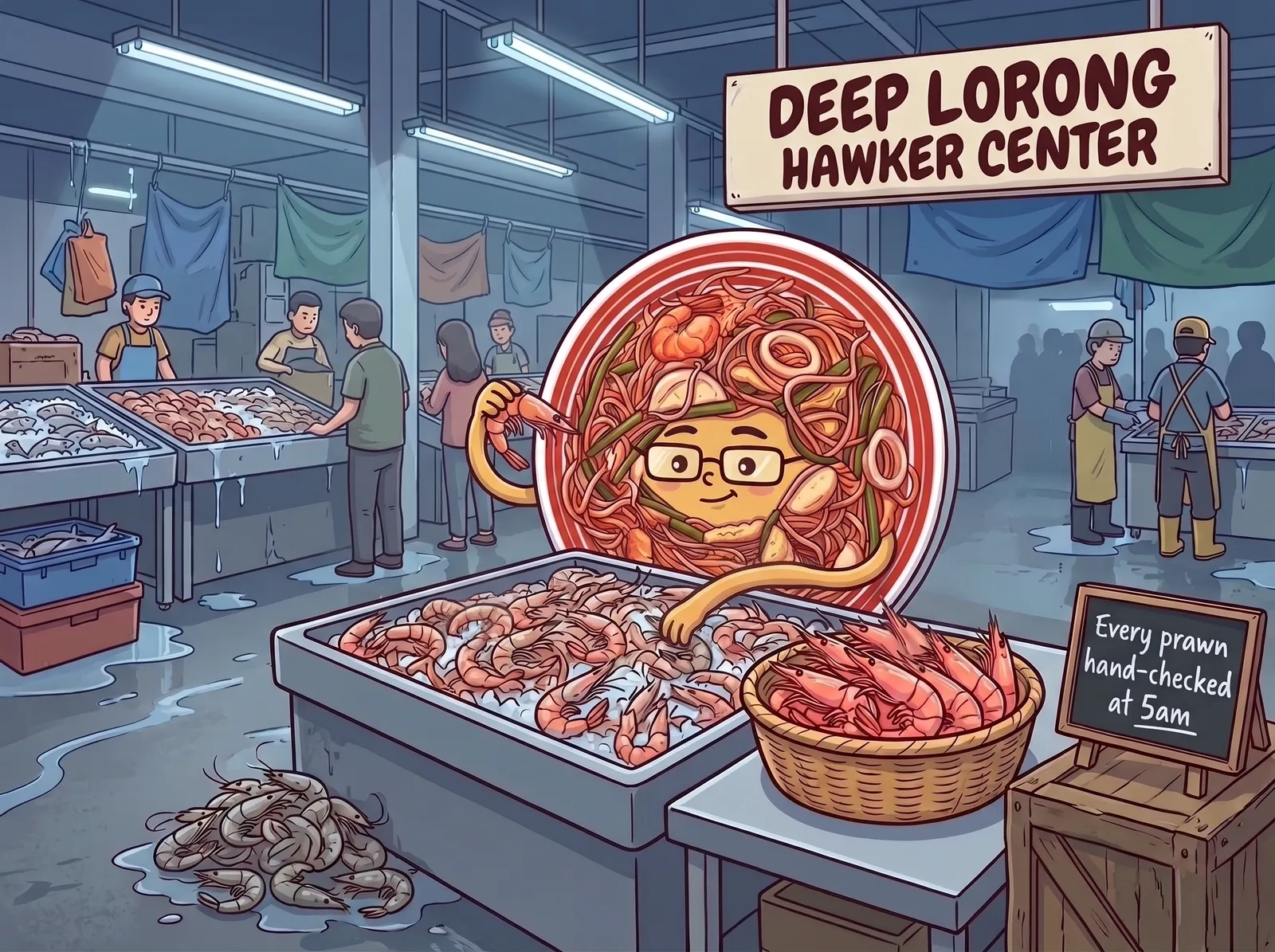
I run a Hokkien Mee stall. Every morning at 5 a.m., you will find me at the wet market, buying and choosing prawns. Fresh ones go into my basket. Spoiled ones stay out. I do not write anything down. I do not run any tests. I pick up a prawn, feel it, look at it, and just know. I do this 500 times before the sun is properly up.
How I just know
Ask me how I know, and I will say, “I just know.” There is nothing difficult in that answer. It means I have held tens of thousands of prawns. Every one taught my hands and eyes a little more. I have a whole library of labelled examples in my head. This one fresh. That one spoiled. When I pick up a new prawn, I never start from scratch. I ask one question: which of the prawns I already know does this one look like?
That is classification. It is the most useful thing a machine can learn. You give it hundreds or thousands of examples. Each one is labelled fresh or spoiled. It builds the same library I carry in my head. Then you hand it something new, and it sorts it.
It sorts your morning too
This is not a hawker thing. Your email does it with every message: this one is spam, this one is real. Your bank does it the moment you tap your card in another country, approve or reject. A farm does it on a belt, ripe from unripe, fruits sorted at speed. It is the same idea every time. Give it enough labelled examples, and it learns to sort the unknown automatically.
You hold the prawn
Let me hand you a prawn.
It is firm, the shell is glossy, and it smells faintly of the sea. Fresh, or spoiled? I give you three seconds.
Pause here for three seconds.
Show the answer
… Fresh.
The second one is dull, slimy to the touch, with a whiff of ammonia. Fresh, or spoiled?
Pause here for three seconds.
Show the answer
… Spoiled.
You did not weigh it or run a lab test. You matched what you felt against prawns you have known your whole life. That is all a classification model does.